

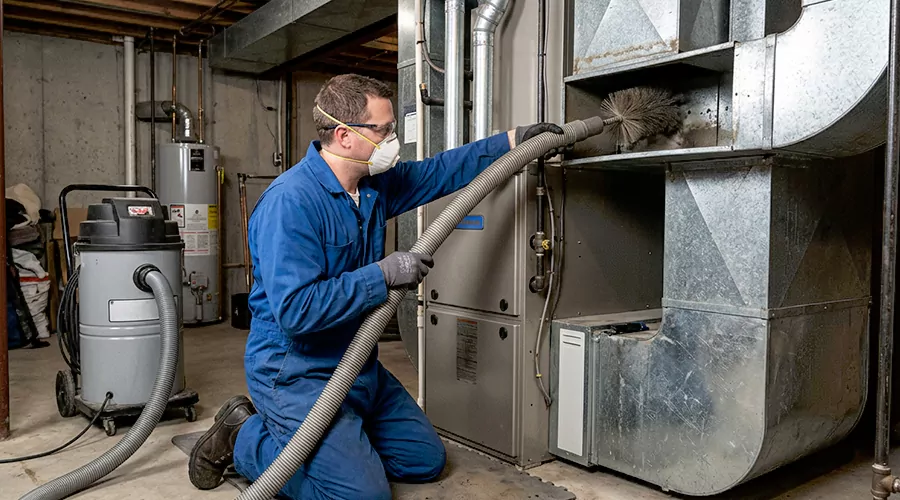
You can fix blocked air ducts by identifying the airflow restriction and removing accessible obstructions such as closed dampers or debris covering vent openings. A dirty filter can also reduce airflow throughout the system. However, internal duct blockages and damaged flexible ducts may require specialized inspection before they can be corrected safely.
Air ducts carry conditioned air between HVAC equipment and individual rooms. When airflow becomes restricted, some areas may receive less heating or cooling than expected. A blockage can affect one branch of the duct system or interfere with airflow throughout the entire house.
The first step is determining whether the duct is actually blocked. Weak airflow can also result from equipment problems or disconnected ductwork. Understanding these differences helps prevent unnecessary duct cleaning and reduces the risk of damaging HVAC components during troubleshooting.
What Causes Air Ducts to Become Blocked?
Air ducts become blocked when an obstruction or damaged component restricts the normal movement of air through the system. Common causes include closed dampers and damaged flexible duct sections. Dirty filters can produce similar symptoms even when the ducts themselves are clear.
Excessive Dust and Debris
Dust naturally accumulates inside HVAC systems over time, but light deposits attached to duct surfaces do not usually create a major airflow restriction. Problems become more likely when substantial loose material collects in one location or physically blocks a passage.
Construction debris can sometimes enter ducts when openings are left uncovered during renovation work. Material may collect near bends or transitions where airflow changes direction. Heavy deposits should be investigated to determine how the debris entered the system before deciding on a cleaning method. Our air duct cleaning services team can assess whether the buildup is significant enough to warrant professional cleaning.
Dirty or Clogged Air Filters
A heavily loaded HVAC filter creates resistance to airflow as particles accumulate in its material. If the restriction becomes significant, the blower may struggle to move sufficient air through the equipment. Rooms throughout the home can then receive less conditioned air even though the duct passages remain open.
This condition is sometimes mistaken for a duct blockage because the symptoms appear at supply vents. Checking the filter is therefore an important first diagnostic step. A correctly sized replacement filter can restore normal operation when the filter was the main source of resistance.
Closed or Partially Closed Dampers
Some duct systems contain balancing dampers that control how much air enters individual branches. A damper may become partially closed after maintenance or an earlier airflow adjustment. This can reduce the amount of conditioned air reaching a particular room.
Adjustable vent registers can create a similar restriction when their louvers are closed. If one room suddenly develops weak airflow, checking the visible register position may reveal a simple explanation. However, hidden balancing dampers should not be changed randomly because their settings affect the overall airflow distribution.
Crushed or Kinked Flexible Ducts
Flexible ducts are commonly installed in attics and other concealed spaces. They can develop sharp bends or compressed sections when improperly supported or when objects rest on them. These restrictions reduce the available passage for moving air.
A severely compressed flexible duct can create symptoms similar to a physical blockage. Cleaning will not correct the problem because the duct's shape is restricting airflow. The damaged section must be evaluated to determine whether it can be repositioned or needs replacement.
Damaged or Collapsed Duct Sections
Duct materials can deteriorate or become damaged over time. Flexible duct liners may tear or collapse, while poorly supported sections can develop restrictions. In some cases, a disconnected duct releases conditioned air into an attic rather than delivering it to the intended room.
A disconnected duct is not technically blocked, but the resulting weak airflow can appear almost identical. This distinction is important because cleaning equipment cannot restore a broken connection. Identifying the physical condition of the duct is necessary before choosing a repair method.
Pest Nests and Foreign Objects
Rodents and other pests can sometimes enter damaged ductwork and leave nesting material inside. Small household objects may also fall through floor registers and become trapped near the opening. These obstructions can restrict airflow when they occupy a substantial portion of the passage.
Pest contamination requires more care than ordinary household dust because debris may contain biological material. Avoid disturbing droppings or nesting material with a normal household vacuum. The source of entry must also be addressed to prevent the problem from returning.
How Can You Tell if an Air Duct Is Blocked?
A blocked air duct often causes noticeably weaker airflow at one or more supply vents. However, reduced airflow alone does not prove that debris is obstructing the duct. Comparing affected rooms with other areas of the home helps determine whether the problem is local or system-wide.
A problem affecting only one room may involve a closed register or damaged branch duct. Weak airflow throughout the entire home suggests that the cause could be closer to the HVAC equipment. Dirty filters and blower problems are examples of conditions that affect several outlets simultaneously.
| Symptom | Possible Cause | What to Check First |
|---|---|---|
| Weak airflow from one vent | Local branch restriction | Register damper and visible opening |
| Weak airflow from all vents | Dirty filter or equipment issue | Filter condition and system operation |
| One room suddenly stops receiving air | Disconnected or damaged duct | Accessible duct connections |
| Whistling near a grille | Restricted opening or excessive air velocity | Register and nearby obstructions |
| Rattling inside a duct | Loose component or foreign object | Accessible opening |
| Visible debris behind a register | Local accumulation | Material near the duct entrance |
| Cooling becomes weak after ice forms | Possible evaporator coil freezing | Visible icing and airflow conditions |
The most useful observation is whether airflow changes are limited to one opening or affect several rooms. A completely closed register may look like a severe duct blockage even though no material is trapped inside. Checking simple causes first prevents unnecessary cleaning.
What Are the Warning Signs of a Blocked Air Duct?
Airflow restrictions can produce several noticeable symptoms before the cause becomes obvious. The signs depend on the location and severity of the restriction. Some problems affect only room comfort, while others can interfere with the HVAC equipment's normal operation.
Watch for these 10 warning signs:
- One supply vent delivers significantly less air than nearby openings.
- A room remains uncomfortable despite normal thermostat settings.
- Airflow suddenly decreases after renovation or attic work.
- Unusual whistling develops around an affected register.
- Visible debris covers a substantial portion of the duct opening.
- The HVAC filter becomes heavily loaded or visibly distorted.
- Some rooms receive normal airflow while others receive very little.
- Ice develops on accessible refrigerant lines or cooling equipment.
- A flexible duct appears crushed or sharply bent in an accessible area.
- The HVAC system repeatedly shuts down or struggles to maintain temperature.
These symptoms can overlap with problems unrelated to blocked ductwork. For example, refrigerant issues and dirty evaporator coils may contribute to cooling problems without a physical obstruction inside a duct. A proper diagnosis should consider the entire airflow path.
If the system shows visible icing, stop cooling operation and investigate the cause. Continuing to operate an air conditioner with restricted airflow can worsen the condition.
How to Check for Blocked Air Ducts Yourself?
A basic inspection can help identify accessible obstructions without dismantling the HVAC system. Start with the air filter and visible registers because these components are easier to examine safely. The goal is to identify simple restrictions before considering concealed ductwork.
Step 1. Compare Airflow in Different Rooms
Turn the HVAC system on under normal operating conditions and compare airflow from several supply vents. Hold your hand near each opening to notice obvious differences, but do not treat this as an accurate airflow measurement. Pay attention to whether the problem affects one room or the entire house.
If most rooms receive normal air while one room has very weak airflow, the restriction may be located in that branch. If every opening seems weak, investigate the filter and equipment operation first. Record the affected rooms so the problem can be tracked.
Step 2. Check the HVAC Air Filter
Switch off the HVAC system and locate the approved filter access area. Remove the filter according to the equipment instructions and check whether it is heavily loaded or damaged. A filter covered with thick debris may be creating unnecessary resistance.
Replace disposable filters when their condition or maintenance schedule requires it. Make sure the replacement is the correct size and compatible with the equipment. Do not operate the HVAC system without its required filter because unfiltered particles can reach sensitive internal components.
Step 3. Inspect Supply Registers
Examine the affected vent covers and check whether their adjustable louvers are open. Remove any furniture or rugs that cover the openings. A blocked register can reduce airflow even when the connected duct remains completely clear.
If the cover contains visible debris, turn off the system before cleaning it. Use a soft vacuum attachment to remove material from the grille and the accessible duct entrance. Avoid forcing tools deeper into the duct because they may damage internal materials.
Step 4. Look for Accessible Duct Damage
If ductwork is visible in an unfinished basement or another safely accessible area, examine it from outside for obvious damage. Look for disconnected joints or flexible sections that appear compressed. Avoid touching electrical equipment or entering unsafe attic spaces during this inspection.
A disconnected duct may release conditioned air into an unintended space rather than deliver it to the room. Crushed flexible material can also restrict the airflow path. Record visible problems with photographs without attempting to cut or dismantle the duct.
Step 5. Check Whether the Problem Persists
After correcting a simple obstruction, restore normal HVAC operation and compare the affected vents again. If airflow returns to its previous level, the visible restriction may have been responsible. If the problem continues, avoid repeatedly changing dampers or opening equipment panels without understanding the system.
A persistent restriction requires more detailed evaluation because the cause may be concealed. The purpose of the household inspection is to identify accessible issues rather than perform a complete mechanical diagnosis.
How to Fix Blocked Air Ducts Based on the Cause?
The correct repair depends on what is restricting airflow. A dirty filter requires a different solution from a crushed flexible duct or disconnected branch. Cleaning is useful only when removable debris is actually responsible for the obstruction.
Fix a Restricted Air Filter
Replace a heavily loaded disposable filter with the correct type recommended by the equipment manufacturer. Make sure the filter fits securely and that its housing closes properly. A filter with excessive airflow resistance can create problems even when it appears more effective at capturing particles.
After replacement, check whether airflow improves at the affected supply openings. If the restriction remains, the filter may not have been the only cause. Avoid operating the system without filtration as a troubleshooting shortcut.
Open an Accidentally Closed Register
Check the adjustable louvers on the affected supply grille and return them to their normal position if they were accidentally closed. Keep nearby furniture and rugs away from the opening so air can move freely.
Avoid changing multiple hidden balancing dampers in an attempt to force more air into one room. These dampers influence the airflow distribution throughout the system. Random adjustments may create comfort problems elsewhere.
Remove Accessible Debris
If loose material is visible near a removable register, turn off the system and remove the cover carefully. Use a vacuum attachment to collect debris that can be reached without force. This method is suitable for ordinary dust or small nonhazardous objects trapped near the opening.
Do not blow compressed air into the duct to move the obstruction. The pressure may scatter debris into other sections or disturb internal insulation. If material extends beyond the reachable area, the location and nature of the blockage should be assessed before removal.
Address Damaged Flexible Ducts
A flexible duct that has collapsed or become severely compressed needs its shape and support corrected. The repair may involve repositioning the duct or replacing a damaged section. Simply cleaning the inside will not solve a physical restriction caused by crushed material.
Visible damage should be documented without cutting into the duct. Improper modifications can introduce air leaks or damage insulation around the connection. The affected section needs to be restored to a suitable configuration for proper airflow.
Investigate Frozen Cooling Equipment
Weak airflow can sometimes occur when the indoor evaporator coil becomes covered with ice. A heavily loaded filter or another airflow restriction can contribute to this condition. The ice itself can further obstruct air passing through the equipment.
If icing is visible, stop the cooling operation and avoid chipping or scraping the ice. The system must thaw safely before the underlying problem is corrected. Restoring airflow without addressing the cause may result in repeated freezing.
What Happens if a Blocked Air Duct Is Not Fixed?
An unresolved airflow restriction can reduce comfort and interfere with HVAC operation. The severity depends on whether the problem affects one branch or the entire system. A minor obstruction near a register is different from a major restriction that prevents sufficient air from moving across the cooling coil.
When one branch receives too little air, the affected room may remain warmer or colder than the rest of the home. A system-wide restriction can have broader effects on performance. Severe cooling airflow problems can contribute to evaporator coil icing and equipment shutdowns.
| Problem Stage | Possible Effect | Appropriate Response |
|---|---|---|
| Minor restriction | Slightly reduced airflow at one vent | Check grille and damper position |
| Moderate restriction | Room struggles to reach the desired temperature | Investigate branch airflow |
| Severe restriction | Multiple rooms receive inadequate airflow | Evaluate filter and system conditions |
| Equipment-related restriction | Cooling coil may ice or system may shut down | Stop affected operation and diagnose cause |
| Physical duct damage | Air is lost or restricted in a branch | Repair or replace damaged section |
The progression is not predictable because different restrictions affect equipment in different ways. A closed vent may remain a local comfort problem, while severe restrictions near the air handler can affect the entire system. Identifying the cause early helps avoid repeated operation under abnormal conditions.
How Much Does It Cost to Fix Blocked Air Ducts in 2026?
The cost of correcting a blocked air duct depends on whether the restriction involves a removable obstruction or an internal mechanical problem. Opening a closed register generally has no direct repair cost, while concealed damage may require diagnostic testing. Cleaning or replacement expenses should be considered only after the cause is identified.
The following figures are broad U.S. cost benchmarks for 2026. They represent different services rather than guaranteed charges for clearing a particular blockage.
| Condition | Possible Work | Estimated 2026 Cost |
|---|---|---|
| Closed register | Adjust accessible louvers | No direct repair expense |
| Visible surface debris | Basic household cleaning | Existing cleaning supplies |
| Unexplained airflow restriction | Air duct inspection | $140 to $380 |
| Suspected duct leakage | Duct leakage testing | $115 to $450 |
| Significant debris inside ductwork | Whole-system cleaning when justified | $271 to $509 |
| Physically damaged ductwork | Section repair or replacement | Requires a damage-specific estimate |
A blockage caused by a dirty filter should not be priced like a duct replacement project. Similarly, cleaning a duct will not fix a disconnected branch or crushed flexible liner. A diagnosis prevents spending money on work that does not address the actual restriction.
What Is the Difference Between a Blocked Duct and a Duct Leak?
A blocked duct restricts the passage of air through a section of the system. A leaking duct allows air to escape or enter through an unintended opening. Both conditions can cause weak airflow at a supply register, but they require different repairs.
A physical blockage may result from debris or a crushed duct section. The blower attempts to move air through the remaining available passage, which can increase resistance. A disconnected supply duct may instead release conditioned air into an attic or other concealed area before it reaches the intended room.
Duct leakage is a common concern in residential forced-air systems. ENERGY STAR estimates that typical homes can lose approximately 20% to 30% of moving duct air through leaks or poorly connected sections. This figure describes leakage rather than physical blockage, but it shows why weak airflow cannot automatically be attributed to debris.
Visual inspection can sometimes reveal a disconnected duct or obvious compression. However, concealed damage may require additional testing. The appropriate repair depends on whether air is being restricted or escaping from the duct.
When Should You Call an HVAC Professional?
Professional inspection is appropriate when airflow remains weak after checking accessible registers and the HVAC filter. Visible duct damage and suspected pest-related blockage also require assessment. These conditions may involve concealed duct sections or internal equipment that cannot be safely evaluated through ordinary household maintenance.
A qualified HVAC technician can measure static pressure and airflow to determine where excessive resistance occurs. The technician may also inspect accessible dampers and examine flexible ducts for physical damage. If the problem involves the cooling equipment rather than the duct, further testing can identify the affected component.
For substantial internal debris, specialized cleaning may be appropriate when the blockage has been documented. However, routine cleaning is not a substitute for repairing collapsed ducts or correcting filtration problems. A clear diagnosis should explain the location of the restriction and the work needed to restore airflow.
Pest contamination and suspected significant biological growth require additional care. Disturbing contaminated material with ordinary cleaning equipment can create unnecessary exposure. The source of entry or moisture must also be corrected to prevent recurrence.
How Can You Prevent Air Duct Blockages?
Preventing airflow restrictions involves keeping accessible openings clear and maintaining the equipment that moves air through the duct system. Regular filter checks help avoid excessive resistance near the air handler. Protecting ductwork from physical damage also reduces the risk of compressed or disconnected sections.
Check Air Filters Regularly
Inspect HVAC filters approximately once a month during heavy heating or cooling use. Replace disposable filters according to the manufacturer's instructions or sooner when they become heavily loaded. Select a filter that matches the equipment's requirements because excessive filtration resistance can reduce airflow.
Keep Supply and Return Vents Open
Avoid placing rugs or furniture directly over supply openings. Return grilles should also remain unobstructed so indoor air can move back toward the HVAC equipment. Check adjustable registers periodically to identify accidental closures, especially in rooms where furniture has recently been rearranged.
Protect Ductwork During Renovations
Keep construction materials away from accessible ducts and avoid placing heavy objects on flexible sections. Cover open registers during dusty work while the HVAC system is off, then remove the coverings before restarting it. Protecting duct openings reduces the chance of large debris entering the airflow path.
Monitor Changes in Room Comfort
Pay attention when a room suddenly receives less conditioned air than before. Check the visible register and filter before assuming the entire duct system is blocked. Documenting changes after renovation work or equipment maintenance can help identify when a restriction developed.
Conclusion
Blocked air ducts can result from debris or physical damage, but weak airflow does not always mean a duct is clogged. Start by checking the filter and accessible vent openings before investigating concealed ductwork. Persistent restrictions may require professional testing to identify the source. Correcting the actual problem is more effective than unnecessary cleaning. This week, compare airflow across your home's supply vents and record any unusual differences.